What the Queen knew

A reflection on Black Panther 2: Wakanda Forever
“Does the construct you create in your mind bring you comfort or torment?”
I recently gave Black Panther: Wakanda Forever, another rewatch.
I love how that movie begins.
The entire film is structured around grief. It opens with T’Challa’s sister Shuri racing against time in her lab to synthesize a cure she can’t finish in time, and everything that follows is the story of a family and a nation trying to figure out what comes next.
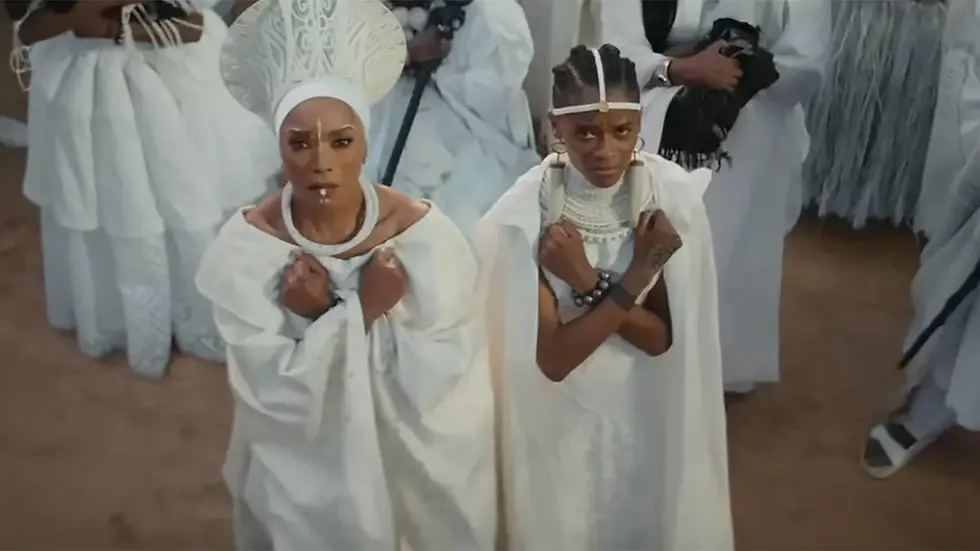
On the one-year anniversary of his death, Queen Ramonda takes Shuri away from her lab and out to a quiet riverbank. The ritual is simple: burn the funeral garments, mark the end of the mourning period, and begin a new kind of relationship with the one you’ve lost.
Ramonda tells her daughter that she came to this place alone, listened to the wind, and found her son in it. She felt his hand on her shoulder.
Shuri, a scientist who has little use for the spiritual traditions of her people, pushes back. What her mother experienced, she says, was a construct of the mind; a comfort the brain manufactures to survive loss.
Ramonda doesn’t argue the point. She simply asks: “And what construct does your mind create when you think of your brother? Does it offer you comfort or torment?” Shuri can’t answer.
She says if she thinks about him too long, all she feels is a desire to watch the world burn. She refuses to burn the garments. She isn’t ready to let go.

The queen’s question is worth sitting with:
It is one thing to understand the concept of constructs and another thing to realize how many of them we accept and create for ourselves without fully realizing that’s what we were doing.
In all honesty, there is hardly anything that isn’t a construct. I know we love to believe in objective realities and impenetrable empirical evidence, but there just isn’t very much of that. I think that’s part of why there is such pushback against gender fluidity, nonbinary existence, and the trans community-life constantly shows you the things you thought you knew for sure aren’t as constant and straightforward as you believed. And that peek through the veil, into uncertainty, can feel like it clouds our own sense of self.
Sometimes, for some of us, that sense of self is all we have left.
Straight. Black. Male.
And yet, even these things are categories of limitation that don’t work for the next person who might look just like me. Where we may seem the same to your eyes, we may not to our own.
Our views of God don’t work much differently.
We all have our own gods, our own theologies, our own interpretations. And those gods have rules and regulations that work suspiciously well with our motivations for self-discipline and improvement. Those gods want the people around us to follow suit and stop causing us to stumble.
Those gods take their shape from the constructs that came before us. The gods the pastors felt spoke through them from week to week. The gods our mothers prayed to for strength not to snatch us up as stubborn youths. The gods the conferences and universities approved. We are all submitting to something inherent to us yet foreign.
That’s what “Deconstruction” really is. It’s not tearing divinity down; it’s the recognition that your objective beliefs were, in fact, constructed in the first place. Adopted. Infused. There are bricks behind the stucco.
You either become curious about the architecture, or you do not. But seeking is not destroying.
Deconstruction might lead to you tearing it all down. It might lead to rebuilding. It might lead to absolutely nothing but the realization of constructs. The acceptance of them.
When the princess is speaking skeptically of the religious ideas and practices of Wakanda, meant to help deal with grief, her critique is that these things are constructs.
The Queen, in response, wisely points out that constructs are inescapable; that the truths the princess lives within are constructs as well. The point is not in realizing that a construct is a construct and laying it on the ground. That is simply where the task begins. The point is to come to a place of quiet and stillness to determine whether your construct brings comfort or torment.
While the Wakandan Queen sends her prayers and thoughts into an ether that a person of another religion wouldn’t believe existed, she was-in fact-at peace. The princess, too intelligent to believe in these myths, was not.
While she wasn’t tied to outdated tradition and was blazing her own path, with all the authority and agency she’d retaken for herself, she was still tormented.

Now, before this starts to sound too much like a defense of organized religion, the princess obviously had the option to believe as her mother did, but that wasn’t bringing her peace either. In fact, her finally falling into the traditions actually took her down the wrong path.


My point is understanding that constructs exist, understanding you exist within one, is not the end of the journey, it’s the first step. It is a tremendous step and a difficult one to make, but it is just the beginning.
It’s important to understand that the “falling away” many churches are seeing is because the constructs they’ve traditionally upheld are tormenting people; and not in subtle ways. The exits aren’t mysterious. People aren’t leaving because they stopped caring about meaning or community, or even God. They’re leaving because the construct stopped holding together under basic scrutiny. Constructs struggle to keep up with revelation and experience. Both have shown there is little more tormenting than belief in an all-powerful, yet arbitrary god.
What this particular construct actually asks of you begins with an omnipotent being who is, by definition, love itself, and then assigns that being an exhaustive list of preferences: who you fall in love with, which words you use for your gender, which words you use with your friends, which day you set aside for worship, whether your music and entertainment meet approval, whether you’ve landed on the correct interpretation of letters written two thousand years ago by people who never imagined you’d still be reading them. The stakes attached to these preferences are absolute: eternal peace or eternal damnation, administered by love itself.
And yet that same construct asks you to hold this alongside a history where the same being sanctioned incest, slavery, genocide, the marriage of daughters to their rapists, a wager with the devil made at the cost of a loyal man’s children, and the occasional angelic execution of thousands over what amounts to administrative infractions. Every week, while the music swells, you may also be reminded that this being (who could give freely) might withhold blessing if the tithe is short.
The construct then asks certain people to treat their own existence as the problem. To refrain. To minimize. To tie a hand behind their back and call it devotion. That is a tormenting construct. Not because the people inside it are foolish, but because the architecture cannot hold the weight it claims to carry.
What good is a construct that turns a blind eye to the greatest atrocities done in its name while condemning the unique expression of divine character it placed in us?
The point the Queen was making was not a plea to bring Princess Shuri back to tradition; it was to tell her not to trade one torment for another.
Your journey may take you far or barely around the corner, but comfort isn’t free. It doesn’t rest right outside of our constructs. It isn’t hiding inside our new ones. It comes down to a choice. For some of us, the first real one we ever make.
Not everyone will understand. Those before us found their comfort in the exact spot we left behind. They cannot understand the issue because of what they went through to find it. They did the heavy lifting for you already.
But that is not how it works. Our paths, no matter how similar they may appear, are our own. We will have our own pace and stride and find ourselves on a unique journey. Even if it looks, from the outside, like leaving the kingdom behind.
This is not a flaw, but a feature. It just sits at odds with how a construct wants to operate. Maybe its patterns and symbols are different. Maybe it’s the rhythms and rhymes. What connects us is not the uniformity in our steps but the conviction to continue forward. To find comfort in the midst of torment, even if only in our minds.
“Does the construct you create in your mind bring you comfort or torment?”


Comments