Ask Me About My Adventism Part 6

Someone (many people) asked (demanded) that I articulate the exact part of Adventist doctrine or which portion of Ellen White’s writings contradict the Bible.
It is not acceptable, it seems, to relay your experience without footnotes, extensive back histories, and passing every singular church member’s vibe check.
If I cannot convince them to leave Adventism, then I do not have the right to talk about my experience in Adventism at all. I must debate them. I must provide more context. I must be lying. I must have a secret sin. I must have never read the Bible or had an experience with God for myself. I must have never met Jesus or given my life over.
It cannot be the teachings of the church that turned me away because all the teachings of the church are pure biblical truth.
There is nothing anyone could ever find in Adventism’s doctrine or Spirit of Prophecy that could be more biblical. No movement has been more divinely led for this time.
These responses, presuppositions, and assumptions are exactly the portion of doctrine that I think contradicts the Bible — the simple idea that we possessed the singular Truth is the problem.
Our church founders, 1800 years into the life of Christianity and a few thousand more in the life of Abrahamic religions in general, decided the code had been perfectly cracked. They decided that nothing that was determined to be ‘biblical’ before or after the Advent movement ever could be ‘biblical’ if it didn’t agree with the Advent movement.
If there is one doctrine or portion of Ellen White’s writings that I take the most issue with, it is this:
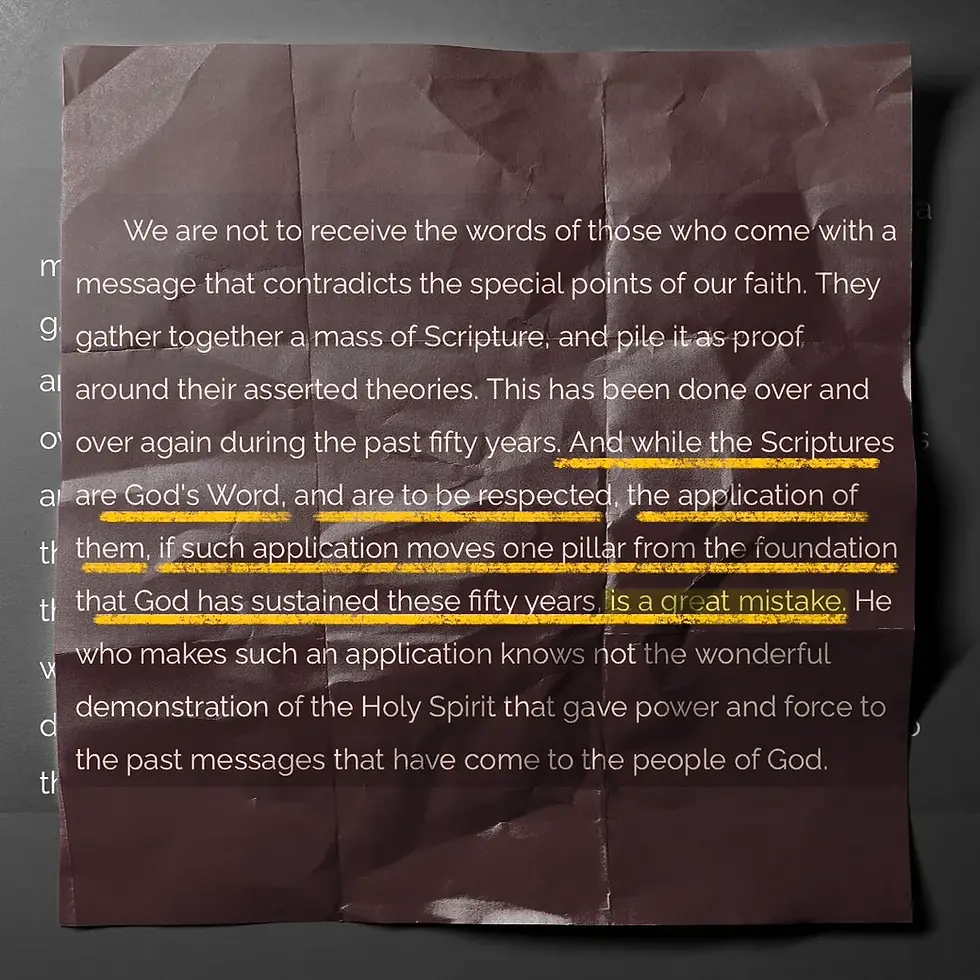
This quote represents a betrayal of what I believe Adventism claims to represent. It embraces tradition over revelation. Fifty years of tradition over thousands of years of reflection, lived experience, and interpretation in the past, and the hundred years since.
It ends interpretation instead of allowing for it to continue. It is a vow to never consider the Word of God when it doesn’t align with what we told you the Word of God says.
Adventism claims, on the record, to have no creed at all. The General Conference's own language: "Seventh-day Adventists accept the Bible as their only creed." Ellen White said the same in her own hand: "The Bible, and the Bible alone, is to be our creed, the sole bond of union." We called ourselves the people of the book — not a people with a book, the people of it.
So read that image again. A message that "contradicts the special points of our faith" is not to be received, full stop. There is no exception for the possibility that the message is simply a better reading of the very book we named as our only authority. An application of Scripture that moves one pillar is "a great mistake," regardless of whether it's true.
In fact, because it may move a pillar, it can’t be true.
This is not Sola Scriptura. This is not using church tradition and Ellen White’s writings as an aid to understanding. It codifies them—carves them in stone. There is therefore now no contradicting the Adventist doctrine. The only way to view the Greater Light (Adventist for ‘the Bible’) is through the Lesser Light (Adventist for ‘Ellen White’s writings’) and her friends.
The same verses that predicted the end of the world eventually led to a sanctuary paper in 1846, the adoption of Sabbath keeping in 1847, the U.S. as the lamblike beast in 1850, the investigative judgment terminology in 1858, the formation of the organized denomination in 1863, the recognition of the ‘Gift of Prophecy' throughout Ellen’s life and work, culminating with The Great Controversy book and worldview.
There is no other possible way to interpret Daniel or Revelation than how they did. The proof for their accuracy is how spectacularly these same interpreters failed to properly interpret the same scriptures 50 years earlier. In fact, it’s the reason God allowed (and perhaps orchestrated) that failure.
We established a system where the Bible’s walls were constructed by our founders. It can only be what they’ve already decided it is. While you’re inside the system, that’s not that big a deal. Who are you to say the walls of your shelter aren’t where they should be? You’re inside. Max capacity is only an issue to someone outside of the walls.
But what if life takes you outside of the walls?
What if we find too much evidence that Earth is older than 6,000 years?
What if you’re well aware of the other ancient Near Eastern flood stories that are older than Noah’s Ark?
What if you’re aware of the Documentary Hypothesis or Sources theory of the Pentateuch? What if you know why you aren’t supposed to ask why Moses appears to write about himself long after his own death?
What if the founders had the entire idea of what apocalyptic literature really is, and what it’s for, wrong? What if that's why nothing happened on October 22, 1844 — not a mix-up about where 'the sanctuary' is, but a wrong genre from the start?
What if a traumatic brain injury can cause seizures and visions? What if grief, exhaustion, and disappointment can forge a bond among the disappointed that feels supernatural?
What if you think the Lesser Light might be too small?
What if you realize that none of these questions has any direct bearing on belief in the divine or supernatural at all but all greatly shift the pillars ‘from the foundation that God has sustained these fifty years?’
It would be a great mistake because you weren’t there when He didn’t show.
This is where the disconnect is in these interactions. They are asking me to tell them where a literalist, fundamentalist, inerrantist, who uses the day-year principle of counting prophetic time, and believes something must have happened on October 22, 1844, would disagree with Adventism’s interpretation of scripture.
Whereas I’m like, “You know Genesis is poetry, right?”
“You know the Bible is a library not a manual, right?”
“Andromeda is 2.5 million light-years away but you can see it with your naked eye. You know what that means, right?”
It was not the idea that life could have rules, or salvation could have strings. It wasn’t even that Jesus—God in the flesh—spoke almost exclusively in metaphor, while the God who inspired the rest of the words must be read with convenient literalism. What bothered me was how damn certain we were about, not the Bible or even God, but about what that specific group of fringe believers decided the Bible must be saying. So certain to declare that not even the Word of God can get in the way of how they read the Word of God. There is no one, ever, that has understood the Bible better than that group of people, and no one who disagrees with them should ever be believed.
The founders and the messenger declared themselves the final arbiters of truth. That is an arrogance Adventism itself taught me no group should claim.

Comments