On Being Black in White Religious Spaces: A Reflection

Updated: 10 hours ago
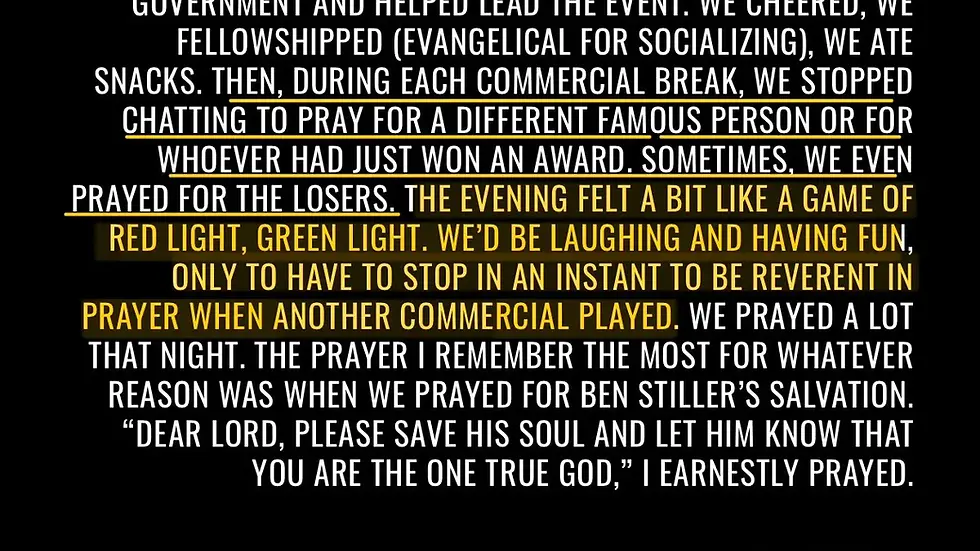
I was reading April Ajoy's book Star-Spangled Jesus. It has the exact energy I hoped for and expected. I reached the chapter about praying for Ben Stiller. Long story short, evangelicals gathered during the Oscars. They played a game: they decided the Spirit had placed the souls of the winners on their hearts. Ben Stiller was one of the souls they prayed to win over for the Lord.
It reminded me of a time after I decided to stop attending an SDA church. My wife and I started going to a local big-box church. We were never big on the sermons. The pastor seemed more interested in discussing what the tithes and offerings were funding. But they had solid coffee, free childcare, and a laser-light worship concert. My wife and I love music.
I wouldn’t say anything there fulfilled our souls. So, we stopped sitting through the sermon part. It was already on a giant projector anyway, since the main service was a parking lot away. We began attending a "Sunday School Small Group."
The Shift to Small Groups
Having grown up in Black churches, I was used to a cacophony of voices. No matter how many little classes you had, they were all in the same sanctuary at the same time. It created a sound only a generationally trained ear could appreciate. The idea of having our own room and flexibility of agenda was initially appealing.
So, we found a little group we were okay with for a while. However, that group was not diverse by any stretch of the imagination, even for Oklahoma. This was around 2016, when White America briefly realized that unarmed Black people die at the hands of law enforcement at an alarming rate. They arguably realized it late.
This realization created tension in the Sunday School Small Group. We debated how significant this issue was and whether we could do anything about it. We engaged in what seemed like the deepest conversation on race that 90% of the room had ever experienced. I struggled to keep my blood from boiling. I remember my wife reaching over, placing a calming hand on me. She looked me directly in the eye, calculated what was heading toward my mouth, and began shaking her head slowly.
The Moment of Revelation
Then it happened. The person leading the class discovered the solution to the "growing" racial tension in our nation and city. She was prepared to enlighten the group.
"We should pray about it. I mean, how often do we argue over whether this is racist or that is racist and let that be the end of the conversation? What if we just prayed about it? 'Where two or more are gathered in my name, there I am in their midst.' How many of us are in this room? Maybe we can't change the world, but we could pray for this city. Let's pray about it."
I looked at my wife, and she realized we had to leave. We needed a reason to exit before my mouth opened.
We faked a call from the nursery, telling us to come get our two-year-old daughter. She was actually enjoying herself that Sunday. We made it to the car just in time for me to finally say:
"Do they not think Black people pray? We never got together and said, 'Hey yo, God! This racism shit has really gotten out of control! Can you tell these White folks to calm down a little bit? Melanin was your idea, wasn't it? Either give them some or take the hatred of it out of them?' It never occurred to us, in all the years we've known about this Christianity thing, to ask the Big Guy to change White folks' hearts? Or do they know we've prayed about it? Obviously, we would have thought to ask the all-powerful creator of everything for help. Maybe no group of affluent White people in Edmond has ever banded together in a small group like this in this former sundown town? Maybe they were the missing link to MLK's Dream?"
The sheer caucasity.
They prayed.
Racism survived.
We didn’t go back.
The Aftermath of Our Experience
Leaving that church felt like a necessary step. It was a step toward reclaiming my voice and my faith. I realized that the conversations we were having were not just about race. They were about understanding, empathy, and the need for genuine connection.
In predominantly white spaces, the dynamics shift. The conversations often lack depth. They can feel superficial. I found myself yearning for authenticity. I wanted to engage in discussions that mattered. I wanted to share my experiences and hear others' stories.
Finding My Voice
Over time, I began to understand the importance of my voice. It mattered. My experiences shaped my perspective. I learned to embrace my identity. I learned to speak up, even when it felt uncomfortable.
I started seeking out spaces where I could connect with others who shared similar experiences. I found communities that valued diversity and inclusion. These spaces allowed me to express my thoughts freely. They encouraged dialogue that was meaningful and impactful.
The Power of Storytelling
Storytelling became my refuge. It became a way to process my experiences. I realized that sharing my story could inspire others. It could spark conversations that needed to happen.
In writing Greatly Disappointed: A Memoir of Inherited Faith, I poured my heart into every page. I wanted to share my journey of faith, identity, and resilience. I wanted readers to understand the complexities of navigating faith in a world that often feels divided.
Conclusion: A Call to Action
As I reflect on my journey, I urge others to engage in these conversations. Don’t shy away from discussing race, faith, and identity. Embrace the discomfort. It’s in those moments that growth occurs.
Let’s create spaces where everyone feels heard. Let’s pray, yes, but let’s also act. Let’s educate ourselves and others. Let’s challenge the status quo. Together, we can work toward a more inclusive and understanding world.
In the end, it’s about connection. It’s about understanding. It’s about creating a community where everyone belongs.
---
I hope this reflection resonates with you. If you're interested in exploring these themes further, consider reading Greatly Disappointed: A Memoir of Inherited Faith. It’s a journey worth taking.
Comments